
Deterministic Generative UI Architecture: Constraining AI to Enterprise Design Systems with Next.js and shadcn/ui
Direct Answer: Generative UI creates chaos when language models output arbitrary HTML and inline styles, breaking brand consistency and accessibility. The enterprise solution—Deterministic Generative UI—constrains the LLM to streaming structured JSON against predefined Zod schema contracts. Next.js 16 and React 19 then bind those validated payloads directly to approved design system components (such as shadcn/ui and Radix UI), ensuring complete brand fidelity and flawless Arabic RTL layout support.
The Hallucination Trap: Why Raw HTML Generation Fails
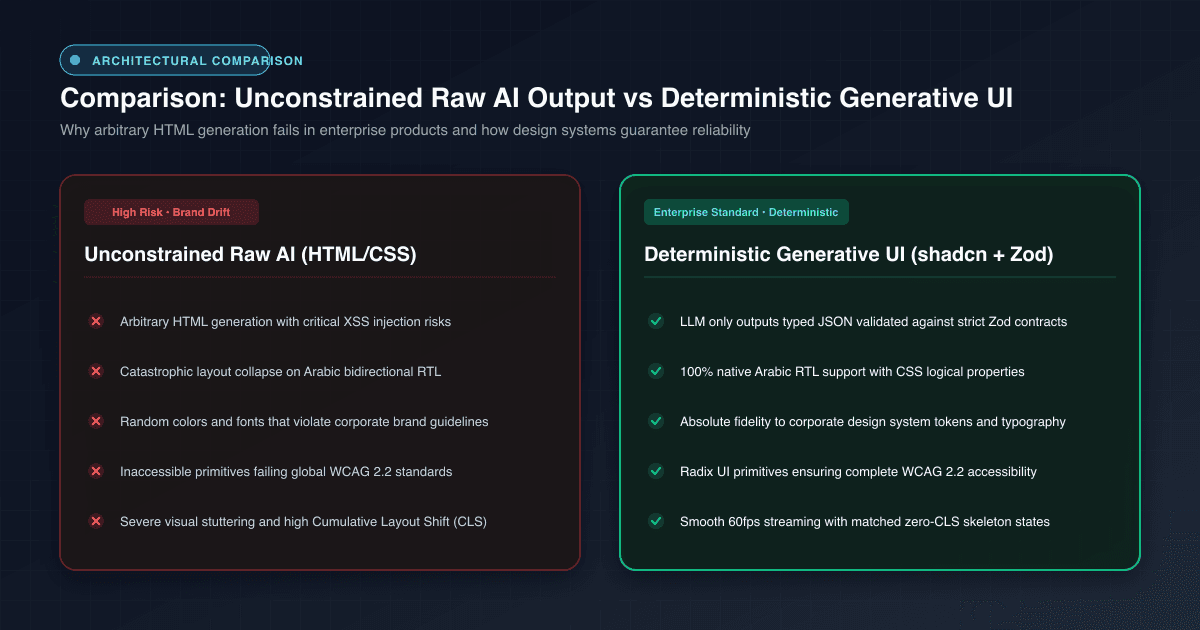
As modern AI applications evolve from text-based conversational interfaces into interactive Generative UI experiences, product teams are eager to dynamically render data tables, metric summaries, and action panels tailored to real-time user intent. However, the naive implementation—prompting models to generate arbitrary HTML markup or inline Tailwind utilities—inevitably creates severe production vulnerabilities.
When language models directly synthesize layout code, enterprise design governance breaks down immediately. The synthesized markup frequently violates corporate color palettes, produces unaccessible DOM structures that fail WCAG audits, generates inconsistent spacing scales, and introduces cross-site scripting (XSS) risks. Furthermore, arbitrary HTML generation consistently breaks bidirectional flow in multilingual and Arabic (RTL) applications, causing reversed punctuation, misaligned icons, and collapsed responsive layouts.
Deterministic Generative UI Architecture
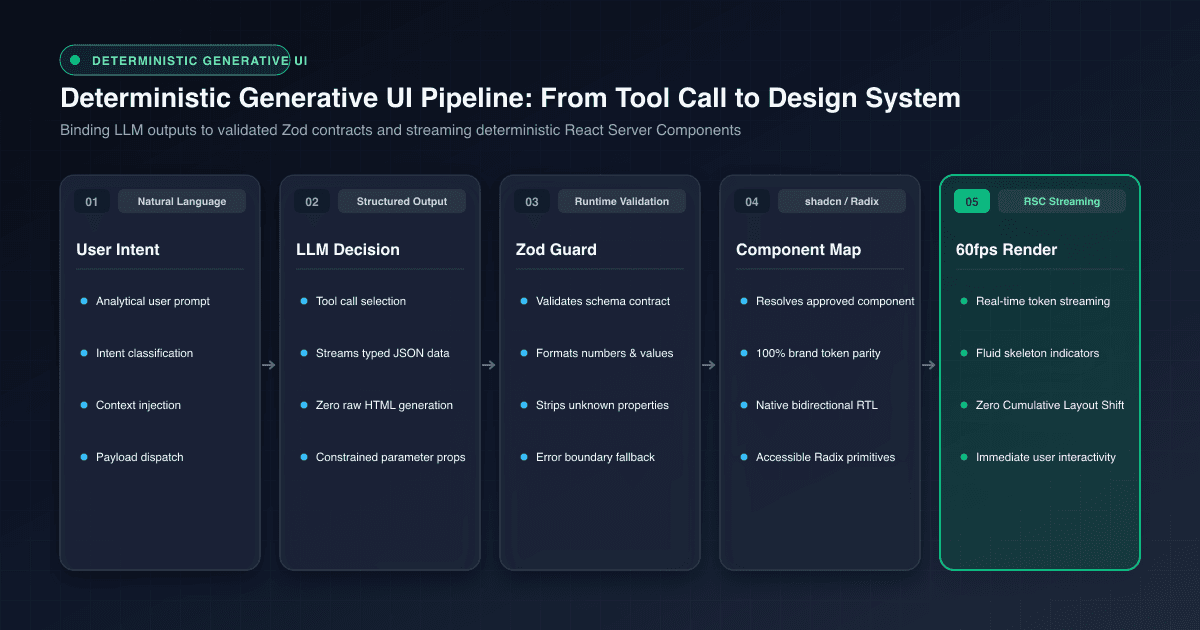
To eliminate this volatility, leading engineering organizations employ Deterministic Generative UI. In this architectural pattern, the language model is completely decoupled from visual styling and rendering mechanics. Instead, the model acts strictly as a decision-making engine emitting structured JSON properties against a strictly governed component catalog:
- Decoupled Presentation and Logic: The model selects which component to display and supplies the data schema; the frontend React runtime renders the approved, battle-tested component implementation.
- Strict Zod Schema Contracts: Every incoming model payload is validated in real time against strict TypeScript/Zod schemas. Malformed props or hallucinated properties are intercepted and sanitized before touching the DOM.
- 100% Brand Token Fidelity: Because rendering is performed exclusively by your design system primitives, typography hierarchies, brand tokens, and dark/light contrast ratios remain immutably preserved.
Constructing Component Catalogs with Zod Schemas in Next.js 16
Within a modern Next.js 16 architecture, engineering teams define approved UI surfaces as concrete programmatic contracts. For example, rather than permitting an LLM to invent an analytics card, we establish an immutable MetricCard Zod schema:
import { z } from 'zod';

export const MetricCardSchema = z.object({
  component: z.literal('MetricCard'),
  props: z.object({
    title: z.string().min(2).max(60).describe('Card title in user locale'),
    value: z.string().describe('Formatted numeric value e.g. 1,420 EGP or +28%'),
    trend: z.enum(['up', 'down', 'neutral']).describe('Directional performance indicator'),
    changePercentage: z.number().describe('Numeric percentage variance e.g. 14.5'),
    comparisonPeriod: z.string().describe('Contextual timeframe e.g. مقارنة بالشهر السابق'),
    badgeText: z.string().optional().describe('Optional status badge e.g. هدف ربع سنوي'),
  }),
});

export type MetricCardProps = z.infer<typeof MetricCardSchema>['props'];
The schema explicitly mandates required fields: title, numeric value, percentage change, and trend direction. When invoking the model API, we enforce Structured Outputs or tool-calling constraints tied directly to this schema. This guarantees that the generated payload matches your component's TypeScript interface with zero hallucinations.
import React from 'react';
import { Card, CardHeader, CardTitle, CardContent } from '@/components/ui/card';
import { Badge } from '@/components/ui/badge';
import { ArrowUpRight, ArrowDownRight, Minus } from 'lucide-react';
import type { MetricCardProps } from './metric-card.schema';

export function MetricCard({ title, value, trend, changePercentage, comparisonPeriod, badgeText }: MetricCardProps) {
  const isPositive = trend === 'up';
  const isNegative = trend === 'down';

  return (
    <Card className="rounded-xl border border-slate-200/80 bg-white p-5 shadow-xs transition-shadow hover:shadow-md">
      <CardHeader className="p-0 pb-2 flex flex-row items-center justify-between">
        <span className="text-xs font-medium text-slate-500">{comparisonPeriod}</span>
        {badgeText && <Badge variant="outline" className="text-[11px] font-medium">{badgeText}</Badge>}
      </CardHeader>
      <CardTitle className="text-sm font-semibold text-slate-700 mt-1">{title}</CardTitle>
      <CardContent className="p-0 mt-2">
        <div className="text-2xl font-bold text-slate-900 tracking-tight">{value}</div>
        <div className="mt-2 flex items-center gap-1.5 text-xs font-semibold">
          {isPositive && <span className="flex items-center text-emerald-600"><ArrowUpRight className="h-4 w-4" />+{changePercentage}%</span>}
          {isNegative && <span className="flex items-center text-rose-600"><ArrowDownRight className="h-4 w-4" />-{changePercentage}%</span>}
          {!isPositive && !isNegative && <span className="flex items-center text-slate-500"><Minus className="h-4 w-4" />0%</span>}
          <span className="text-slate-400">معدل التغير</span>
        </div>
      </CardContent>
    </Card>
  );
}
Looking to establish a comprehensive, accessible design system tailored for enterprise web and mobile applications? Explore our Enterprise UI/UX Design & Design System Services to build an enduring visual foundation.
Streaming Generative UI with React 19 and Server Actions
The defining operational advantage of this architecture is progressive streaming. Leveraging React Server Components (RSC) and streaming primitives in Next.js 16, applications deliver fluid, 60fps progressive rendering without waiting for full LLM inference completion:
- Progressive Component Streaming: The server streams component shells immediately upon parsing the opening JSON tokens, rendering coordinated skeleton loaders that transition seamlessly into interactive controls.
- Zero Layout Shift (CLS 0.00): Because component boundaries and dimensional constraints are governed by standard design tokens, data streams into fixed slots without causing disorienting layout shifts.
- Optimized Client Bundles: Schema validation and model coordination execute on the Next.js server runtime, keeping client bundle sizes lightweight and maximizing Core Web Vitals performance.
Discover how we architect high-performance, edge-rendered web platforms using modern React and Next.js through our Full-Stack Web Development & Engineering Services tailored for demanding products.
Governance for Bidirectional RTL and Multilingual Systems
For applications deployed in Egypt and across the MENA region, flawless right-to-left (RTL) rendering is a non-negotiable requirement. Naively generated HTML routinely reverses numeric sequences, misplaces directional chevron indicators, and mishandles localized currencies (such as EGP and SAR).
By restricting generative rendering to battle-tested shadcn/ui and Radix UI primitives, all components automatically utilize CSS logical properties (such as ps-* and pe-*). The system guarantees that typography scales, Arabic font metrics (such as FS Albert or Cairo), and bidirectional flex layouts operate with mathematical consistency.
Four-Step Adoption Blueprint for Frontend and Product Teams
To successfully adopt deterministic generative UI across your engineering workflows, follow this pragmatic rollout blueprint:
- 1. Audit Candidate Primitives: Identify the most frequent analytical and interactive patterns (metric cards, data tables, comparison grids, confirmation dialogs).
- 2. Author Strict Zod Schemas: Write granular validation schemas with descriptive property comments that guide the LLM's analytical choices.
- 3. Implement Fallback Error Boundaries: Establish graceful, branded degradation states that render safe fallback messages if network streams disconnect.
- 4. Monitor Telemetry and User Engagement: Track client interaction rates with dynamically generated components and expand your schema library based on validated user demand.
For transparent investment frameworks and delivery milestones regarding enterprise design systems and Next.js engineering, review our Software Engineering Pricing & Milestone Packages to plan your initiative.
Conclusion: Controlled AI That Fortifies Brand Authority
Generative UI does not represent an abandonment of frontend design discipline; rather, it elevates the necessity of a robust, typed design system. When AI is channeled through validated component contracts, your product delivers tailored, intelligent interactions while preserving uncompromised brand integrity, accessibility, and speed.
Frequently Asked Questions
Quick answers about this topic
Raw HTML generation bypasses design tokens, breaks accessibility standards (WCAG), exposes applications to XSS vulnerabilities, and routinely breaks responsive and bidirectional RTL layouts.
It enforces strict schema contracts (e.g. Zod) via Structured Outputs. The LLM can only emit valid JSON matching approved component properties; it cannot invent arbitrary HTML tags or styling.
Yes. By combining React Server Components (RSC) with fixed design system containers and skeleton fallbacks, incoming JSON data populates predefined slots with zero Cumulative Layout Shift (CLS 0.00).
Because components are built on top of shadcn/ui and Radix UI using CSS logical properties, all generated views inherently respect RTL orientation, Arabic typography, and proper text alignment.
Related Articles
View all articles →
7 Open-Source macOS Apps to Elevate Productivity and System Control
An editorial deep dive into seven open-source macOS tools for window management, screen recording, and hardware tuning, complete with workflows and compatibility notes.

Exploring Bencho: Interactive UI Component Inspiration
Bencho introduces a visual catalog of interactive UI blocks that developers and designers can test live, offering an alternative to static design mockups.

Playwright MCP and Autonomous Browser Agents: Building Resilient, Deterministic QA Pipelines in 2026
An authoritative engineering guide to Playwright MCP: leveraging accessibility trees (AXTree) for deterministic UI testing, sandboxing test runners, and converting exploratory AI agent sessions into robust TypeScript regression suites.
Want this for your product?
Send a short note about your project. We will review it and explain the next useful step.
Contact Our Team