
Enterprise AI Gateway Architecture: Multi-Model Routing, Cost Optimization, and BYOK Governance in 2026
Direct Answer: An AI Gateway is an enterprise reverse proxy positioned between internal applications and external language model providers (such as OpenAI, Anthropic, Google, and private self-hosted endpoints). It delivers automated multi-provider failover, slashes token bills by up to 40% through semantic similarity caching, enforces team-level budget caps, and secures corporate API credentials through centralized Bring Your Own Key (BYOK) governance.
The Pre-Gateway Crisis: Proliferation, Outages, and Uncontrolled Spending
As modern enterprises accelerate the integration of large language models across customer-facing products and internal operational tooling, engineering teams inevitably collide with severe architectural sprawl. Individual teams and feature engineers frequently integrate directly with distinct provider APIs, scattering sensitive API keys across decentralized configuration files, environment secrets, and repository branches.
This disorganized topology produces three critical operational liabilities: First, unbuffered application downtime. When a primary provider experiences regional latency spikes, HTTP 503 service outages, or aggressive 429 rate limit rejections, the company's application crashes immediately because no automated failover routing exists. Second, unmonitored financial exposure. Finance departments are routinely ambushed by runaway end-of-month API invoices with zero granular attribution identifying which teams generated the costs. Third, regulatory non-compliance caused by uninspected payloads transmitting proprietary corporate intellectual property and customer personally identifiable information (PII) to foreign cloud servers.
The Four Core Pillars of Enterprise AI Gateway Architecture
A production-ready AI Gateway functions as an intelligent, high-throughput reverse proxy governing all outbound model traffic through four foundational architectural pillars:
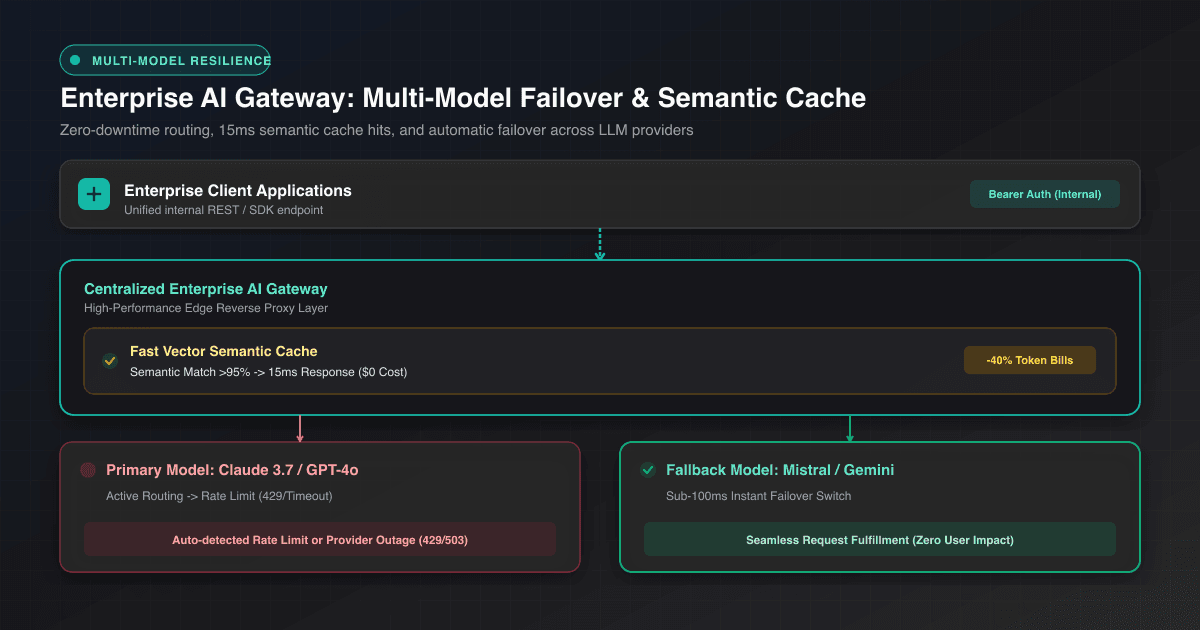
- 1. Intelligent Routing and Automated Failover: If the primary model endpoint experiences latency spikes or service degradation, the gateway reroutes requests within milliseconds to a preconfigured fallback model with zero disruption to end users.
- 2. High-Performance Semantic Caching: Persisting historical query embeddings in a vector cache prevents redundant upstream calls for semantically identical prompts, dramatically cutting token expenses.
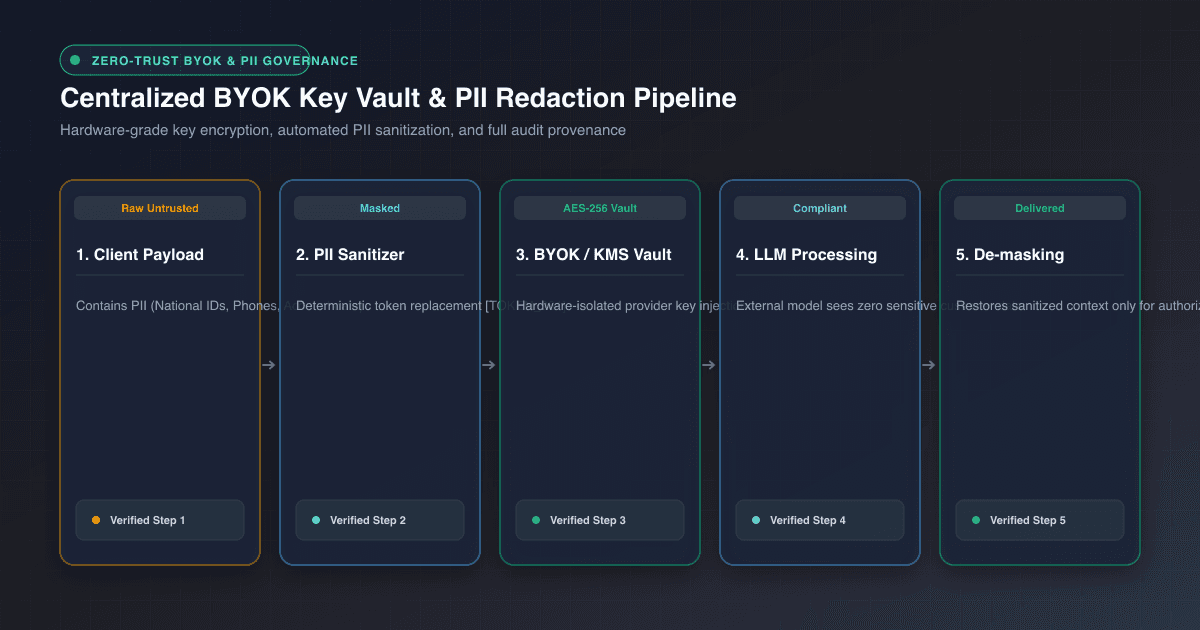
- 3. Centralized BYOK Key Management: Enterprise API credentials are encrypted within centralized Hardware Security Modules (KMS). Downstream client applications authenticate using scoped internal bearer tokens without ever accessing raw provider keys.
- 4. Granular Financial Governance and Rate Limiting: Hard monthly spend limits, token rate limiting, and real-time telemetry dashboards ensure strict budget enforcement per department or application tier.
Learn how we design, harden, and monitor scalable cloud infrastructure and reverse proxies through our Enterprise Cloud Infrastructure & Managed DevOps Services engineered for high-availability systems.
Architectural Trade-Offs: Managed Cloud Gateways vs Self-Hosted Open Source
Engineering leaders must evaluate the operational trade-offs between managed edge platforms and dedicated self-hosted gateway clusters:
- Managed Cloud Gateways (e.g. Vercel AI Gateway, Cloudflare AI Gateway): Offer rapid zero-configuration deployment with global edge distribution, ensuring minimal routing latency, but offer limited custom extensibility for proprietary on-premise model hosting.
- Self-Hosted Open Source Gateways (e.g. Portkey, LiteLLM, Kong AI Gateway): Deliver complete architectural autonomy and strict data residency compliance, allowing enterprises to seamlessly bridge public cloud models with private on-premise vLLM or Ollama clusters.
To evaluate bare-metal servers, private virtualization, and edge hosting configurations for your private AI gateway infrastructure, explore our detailed Enterprise Hosting & Cloud Server Comparison Guide for technical benchmarks.
Cost Reduction Strategies: Slashing Token Expenses with Semantic Caching
Semantic caching represents the most impactful architectural cost-reduction mechanism in enterprise AI systems. In standard implementations, if two users submit 'What are your enterprise package fees?' and 'How much does your subscription cost?', traditional gateways dispatch two independent, billable API calls to the upstream model provider.
An enterprise AI Gateway vectorizes prompt inputs in real time. When incoming vector cosine similarity exceeds a defined threshold (typically 95%), the gateway serves the cached completion directly with sub-15ms latency and zero upstream token cost. Furthermore, intelligent model tiering routes low-complexity conversational queries to fast, cost-effective models while reserving expensive frontier models exclusively for intensive analytical reasoning.
import { NextRequest, NextResponse } from 'next/server';

interface ProviderConfig {
  name: string;
  endpoint: string;
  model: string;
  timeoutMs: number;
}

const PROVIDER_CASCADE: ProviderConfig[] = [
  { name: 'anthropic-primary', endpoint: 'https://api.anthropic.com/v1/messages', model: 'claude-3-7-sonnet', timeoutMs: 8000 },
  { name: 'google-secondary', endpoint: 'https://generativelanguage.googleapis.com/v1beta/models', model: 'gemini-2.5-pro', timeoutMs: 6000 },
  { name: 'mistral-failover', endpoint: 'https://api.mistral.ai/v1/chat/completions', model: 'mistral-large-latest', timeoutMs: 5000 },
];

export async function POST(req: NextRequest) {
  const { prompt, userId } = await req.json();

  // 1. Semantic Vector Cache Check (<15ms, $0)
  const cachedResponse = await checkSemanticCache(prompt, { similarityThreshold: 0.96 });
  if (cachedResponse) {
    return NextResponse.json(
      { result: cachedResponse, source: 'semantic-cache', latencyMs: 12 },
      { headers: { 'x-cache': 'HIT' } }
    );
  }

  // 2. Cascade execution across providers with automated failover
  for (const provider of PROVIDER_CASCADE) {
    try {
      const controller = new AbortController();
      const timer = setTimeout(() => controller.abort(), provider.timeoutMs);

      const res = await fetch(provider.endpoint, {
        method: 'POST',
        headers: { 'Authorization': `Bearer ${process.env[`${provider.name.toUpperCase()}_API_KEY`]}` },
        body: JSON.stringify({ model: provider.model, messages: [{ role: 'user', content: prompt }] }),
        signal: controller.signal,
      });
      clearTimeout(timer);

      if (res.ok) {
        const data = await res.json();
        return NextResponse.json({ result: data, provider: provider.name });
      }
    } catch (error) {
      console.warn(`Provider ${provider.name} failed or timed out. Falling over to next provider...`);
    }
  }

  return NextResponse.json({ error: 'All upstream model providers failed' }, { status: 503 });
}
Cybersecurity, Compliance, and Real-Time PII Masking
Data privacy regulations across Egypt, the GCC, and European markets enforce strict compliance standards governing the handling of sensitive consumer data. An AI gateway functions as a deterministic security boundary inspecting and sanitizing all payload transmissions:
- Automated PII Redaction: Real-time detection and tokenization of national identity numbers, payment card data, and corporate email addresses before prompt egress to external LLM providers.
- Prompt Injection Firewall: Semantic heuristic evaluation inspects incoming payloads to intercept prompt injection attacks and malicious jailbreak patterns before model processing.
- Immutable Audit Logging: Cryptographically verifiable logging of all prompt transactions, token counts, and latency metrics ensures comprehensive enterprise compliance audits.
For clear budgeting benchmarks and transparent software engineering retainer tiers, consult our comprehensive Software Engineering Pricing & Architectural Milestone Packages to plan your modernization roadmap.
Webdivs Engineering Roadmap for Enterprise AI Gateway Adoption
A successful AI Gateway rollout begins with an inventory audit mapping all active model integrations across your engineering stack. We then deploy the gateway proxy within an isolated staging cluster, validating multi-provider failover mechanics, semantic cache hit ratios, and credential encryption before shifting production workloads. The result is immediate cost containment, continuous uptime, and enterprise-grade security governance.
Frequently Asked Questions
Quick answers about this topic
An AI Gateway acts as a centralized reverse proxy that routes, caches, logs, and secures all application interactions with language model providers, ensuring uptime and cost control.
Standard HTTP caching requires exact character string matches. Semantic caching uses vector embeddings to recognize conceptually identical prompts phrased in different words.
When a primary provider returns a 429 rate limit or 503 server error, the gateway automatically redirects the request to an equivalent secondary provider in milliseconds.
Yes. The gateway includes automated PII masking that intercepts, redacts, or encrypts sensitive identity and financial information before payloads leave the internal network.
Related Articles
View all articles →
Want this for your product?
Send a short note about your project. We will review it and explain the next useful step.
Contact Our Team