
Hardening AI Agent Sandboxes: Defense-in-Depth Architecture for Autonomous Tool Execution in 2026

Direct Answer: AI agent sandboxing requires isolation architectures far beyond standard Docker containers. Because standard containers share the host operating system kernel, they remain vulnerable to kernel breakouts triggered by indirect prompt injection. Production defense-in-depth demands lightweight MicroVMs (such as AWS Firecracker or Google gVisor), aggressive syscall filtering via Seccomp, strict default-deny network egress firewall rules, and cryptographic Human-in-the-Loop (HITL) authorization gates for high-consequence operations.
The Autonomous Agent Threat Model: Prompt Injections and Escape Vectors
In 2026, enterprise software engineering has transitioned rapidly from conversational chatbots to autonomous agents empowered with active tool execution: executing shell commands, compiling and running Python code, querying enterprise databases, and automating browser interactions. While transformative for productivity, this level of autonomy introduces unprecedented cybersecurity risks to corporate infrastructure.
The most insidious vector is indirect prompt injection. When an agent processes untrusted web pages, customer support tickets, or third-party datasets containing adversarial hidden payloads, those payloads can hijack the agent's reasoning framework. The compromised agent can be instructed to spawn background reverse shells, scan internal subnet IP ranges, extract environment secrets (.env files), and exfiltrate proprietary source code across the internet.
The Container Illusion: Why Standard Docker Fails Agent Workloads
A dangerous misconception prevalent among infrastructure teams is relying on standard Docker containers (docker run) as an impenetrable security boundary for agent execution. Architecturally, traditional containers share the underlying host operating system kernel:
- Kernel Breakout Vulnerabilities: If an agent executes an untrusted C binary or Python script that exploits an unpatched Linux kernel vulnerability, the attacker breaks out of the container and assumes root access on the physical host server.
- Privilege Escalation Risks: Misconfigured container capabilities (such as CAP_SYS_ADMIN) provide straightforward privilege escalation pathways directly to host storage volumes.
- Lateral Network Movement: Containers attached to default bridge networks can port-scan and attack adjacent internal microservices, Redis caches, and database clusters.
Defense-in-Depth: Multi-Layered Sandbox Architecture
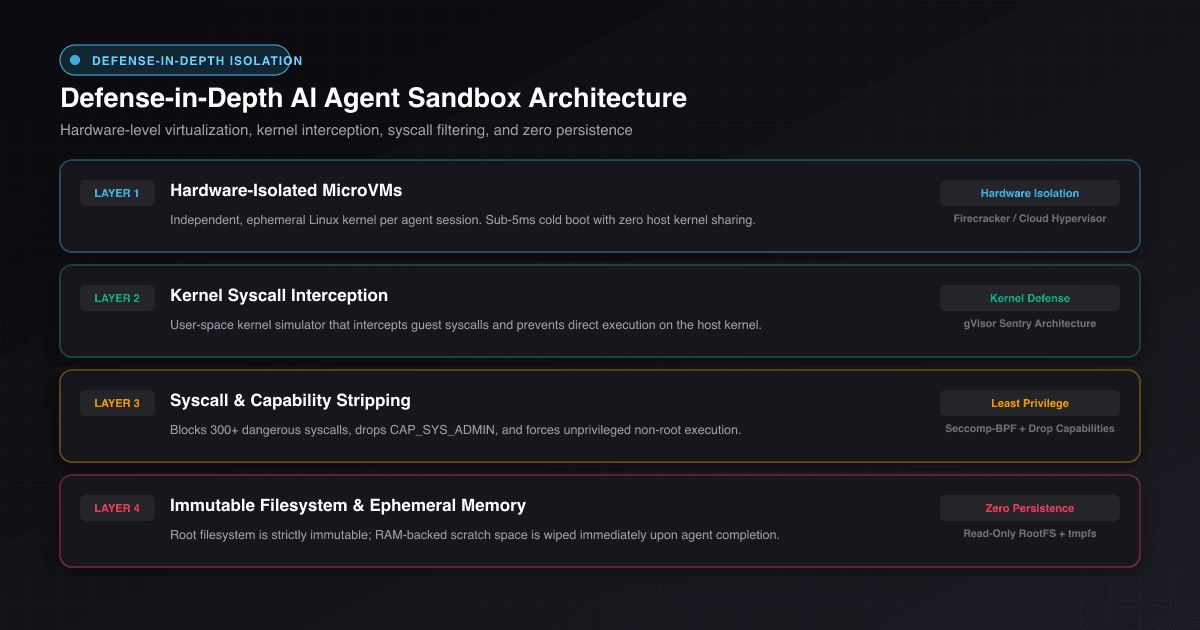
To establish robust enterprise-grade isolation, Webdivs architects a multi-tiered defense-in-depth perimeter combining four distinct containment layers:
- 1. Hardware-Isolated MicroVMs: Leveraging virtualization engines like AWS Firecracker or Kata Containers. Each agent workload boots a dedicated, minimalist Linux kernel within 5 milliseconds, enforcing hardware-level hypervisor boundary isolation.
- 2. User-Space Kernel Interception (gVisor): Deploying runsc runtimes that intercept application system calls in user space, completely insulating the host kernel from arbitrary execution.
- 3. Restrictive Syscall Filtering (Seccomp-BPF): Disabling over 300 non-essential system calls and stripping all Linux capabilities (CAP_DROP_ALL), restricting the execution environment strictly to mathematical computation.
- 4. Ephemeral Read-Only Root Filesystems: Mounting root filesystems as immutable read-only volumes with ephemeral memory-backed temporary workspaces (tmpfs) destroyed immediately upon task termination.
{
  "defaultAction": "SCMP_ACT_ERRNO",
  "architectures": ["SCMP_ARCH_X86_64", "SCMP_ARCH_AARCH64"],
  "syscalls": [
    {
      "names": [
        "read", "write", "openat", "close", "fstat", "lseek",
        "mmap", "mprotect", "munmap", "brk", "rt_sigaction",
        "rt_sigprocmask", "ioctl", "nanosleep", "getpid", "exit_group"
      ],
      "action": "SCMP_ACT_ALLOW"
    },
    {
      "names": [
        "ptrace", "sys_chroot", "pivot_root", "kexec_load",
        "mount", "umount2", "reboot", "init_module", "delete_module"
      ],
      "action": "SCMP_ACT_KILL"
    }
  ]
}
Discover how we architect hardened cloud environments, container orchestration platforms, and proactive security monitoring through our Managed Cloud Hosting & Enterprise DevOps Solutions designed for zero-trust workloads.
Network Egress Firewalls: Eliminating Data Exfiltration Routes
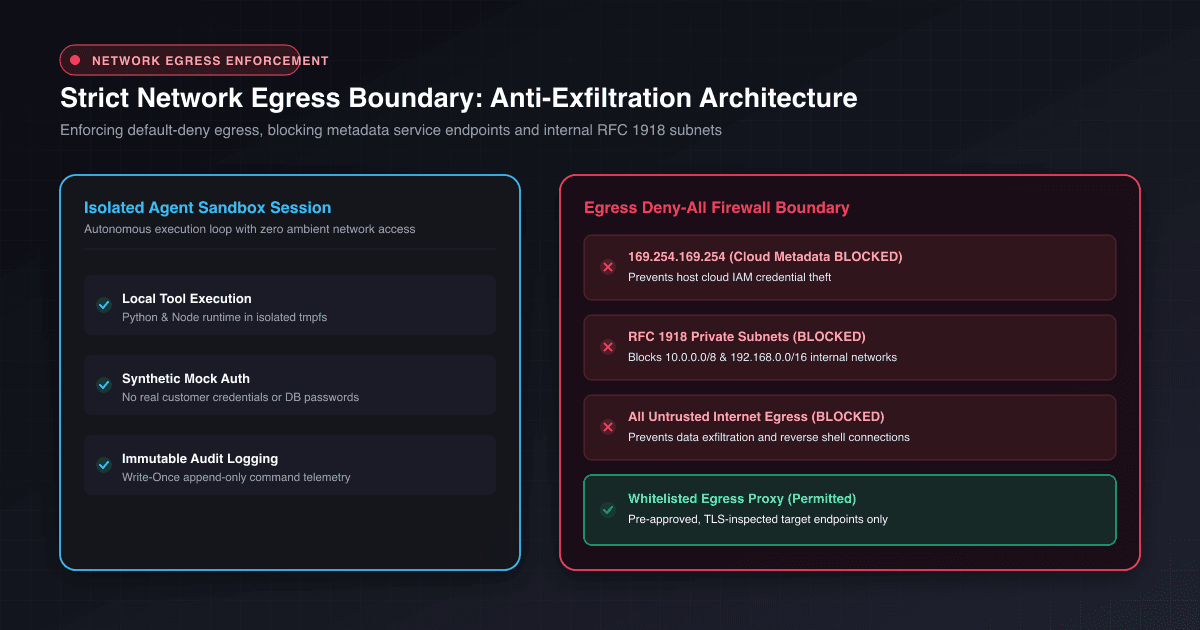
The primary objective of any remote agent exploit is exfiltrating captured data to external command-and-control servers. Restricting outbound network traffic is the single most effective barrier against data breaches:
- Default-Deny Outbound Egress: Completely block all outbound internet traffic from the sandbox environment by default.
- Cloud Metadata Interception: Strictly block outbound connections to the link-local metadata address 169.254.169.254, preventing the agent from harvesting host cloud IAM role credentials.
- Private Subnet RFC 1918 Isolation: Deny all routing to internal IP blocks (10.0.0.0/8, 172.16.0.0/12, 192.168.0.0/16) to stop internal lateral network reconnaissance.
- Forward Proxy Allowlisting: If an agent requires external API connectivity, all traffic must terminate at an authenticated forward proxy enforcing strict cryptographic domain whitelisting and TLS inspection.
#!/bin/bash
# Enterprise AI Agent Egress Firewall Configuration
set -euo pipefail

# 1. Flush existing user-defined chain
iptables -F AI_SANDBOX_EGRESS 2>/dev/null || iptables -N AI_SANDBOX_EGRESS

# 2. Block Cloud Metadata IP (AWS/GCP/Azure)
iptables -A AI_SANDBOX_EGRESS -d 169.254.169.254 -j DROP

# 3. Block Private Subnets (RFC 1918) to prevent lateral internal movement
iptables -A AI_SANDBOX_EGRESS -d 10.0.0.0/8 -j DROP
iptables -A AI_SANDBOX_EGRESS -d 172.16.0.0/12 -j DROP
iptables -A AI_SANDBOX_EGRESS -d 192.168.0.0/16 -j DROP

# 4. Allow established connections & route external HTTPS via scoped egress proxy
iptables -A AI_SANDBOX_EGRESS -m state --state ESTABLISHED,RELATED -j ACCEPT
iptables -A AI_SANDBOX_EGRESS -p tcp --dport 443 -d proxy.internal.webdivs.net -j ACCEPT

# 5. Default-Deny drop everything else
iptables -A AI_SANDBOX_EGRESS -j DROP
Learn how our engineering team crafts secure, high-performance web applications that comply with international cybersecurity frameworks by visiting our Enterprise Web Application Development Services for modern platforms.
Human-in-the-Loop (HITL) Governance for Critical Tool Invocations
Technical containment must be paired with operational policy governance. In enterprise AI architectures, agent toolsets are classified across a three-tier risk matrix:
Low-risk tools (such as reading local cached files or calculating mathematical models) execute autonomously inside the sandbox. Medium-risk operations are bound to strict rate limits. High-consequence actions—such as modifying production databases, issuing customer refunds, deleting cloud resources, or deploying application code—strictly require Human-in-the-Loop (HITL) intervention with multi-factor cryptographic approvals before execution.
Immutable Forensic Audit Logging
To maintain regulatory compliance and support incident response, every agent interaction must be preserved in tamper-proof audit trails. The system logs raw reasoning chains, tool input arguments, execution outputs, and network connection attempts directly into append-only, Write-Once-Read-Many (WORM) storage for exhaustive forensic investigation.
Learn more about our foundational engineering principles, cybersecurity governance, and technical leadership by reviewing the Webdivs Engineering Standards & Operational Excellence overview.
Conclusion: Engineering for Zero Trust Autonomous Execution
Never assume an intelligent model will self-police or respect conversational guidelines. True enterprise cybersecurity assumes that every agent will encounter adversarial manipulation, and engineers the sandbox to guarantee that even a compromised agent cannot escape, exfiltrate data, or damage the underlying business infrastructure.
Frequently Asked Questions
Quick answers about this topic
Standard Docker containers share the host Linux kernel. If an agent executes an exploit that breaches the kernel, it gains root access to the physical host server.
MicroVMs run each agent in its own hardware-isolated virtual machine with a dedicated kernel, booting in milliseconds with hypervisor-enforced boundary protection.
Unrestricted egress allows compromised agents to establish reverse shells, exfiltrate confidential files, and steal cloud IAM credentials via metadata endpoints.
HITL must be enforced for all high-consequence operations, such as modifying databases, financial transactions, deleting resources, or deploying production code.
Related Articles
View all articles →
Want this for your product?
Send a short note about your project. We will review it and explain the next useful step.
Contact Our Team